Saxo Bank 2026: Up to €500 in Free Trading Fees
Be the first to rate this offer
Promo offer

Saxo Banque
Referral offerValid on Saxo Banque • Click to claim the offer
About this offer
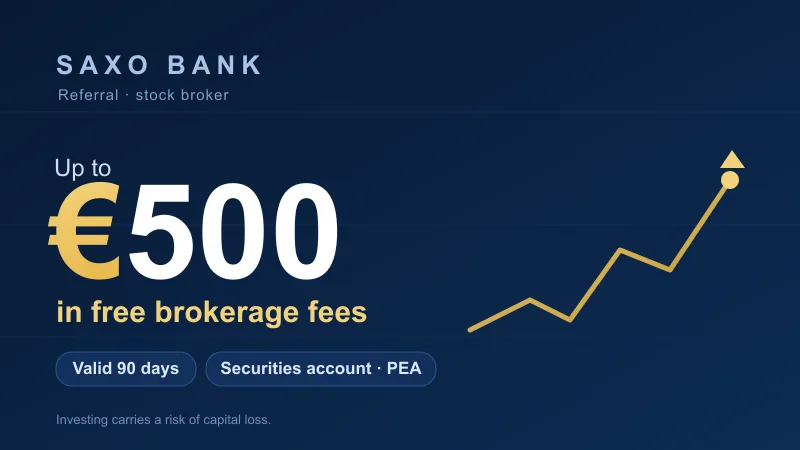
- Saxo Bank referral offer: up to €500 in free brokerage fees, valid 90 days, for both the new client and the referrer, via our partner link (no code to enter)
- A securities account with access to 70+ global exchanges and 150+ Amundi ETFs with no purchase brokerage until 31 December 2026
- Brokerage fees from 0.08% per order (min €2) on Euronext — competitive on mid-to-large orders
- A subsidiary of Saxo Bank A/S (Denmark, founded 1992), majority-owned by J. Safra Sarasin since 2025
- Investing carries a risk of capital loss — derivatives can cause losses exceeding the capital invested
- Compare with Degiro and Interactive Brokers.
Click the promo link to access the Referral offer on Saxo Banque. This offer is verified and regularly updated.
How to activate a Saxo Bank welcome offer
Saxo Bank runs a referral offer for new clients: up to €500 in free brokerage fees, valid for 90 days, for both the new client and the referrer. It activates via a partner link — there is usually no alphanumeric code to enter at account opening. The process is fully online: go to the Saxo Bank site, click "Open an account", choose your account type, complete the regulatory investor-profile questionnaire, then finish online identity verification. Once your first securities account is opened via our link and funded within 30 days, the free-fee credits are set automatically within 2 business days. "Saxo Bank promo code", "welcome offer" and "referral" all describe the same mechanism.
Opening a Saxo Bank account
Opening a Saxo Bank account is fully online, with no branch appointment. Allow about 20-30 minutes, including the mandatory investor-profile questionnaire (a European regulatory requirement). Saxo Bank offers several account types: tax-advantaged local wrappers where available (such as a French PEA), and a standard securities account (taxable) with no cap or geographic restriction and access to all global markets. Identity verification is online (ID + selfie). The account is operational once validated, usually within 24-48 business hours.
The Saxo Bank referral offer: up to €500 in free trades
The Saxo Bank referral offer gives both the new client and the referrer up to €500 in free brokerage fees, valid for 90 calendar days — effectively commission-free orders (up to €500) for the first three months. It applies to a first securities account funded within 30 days, and covers stocks, ETFs, options, futures and bonds (excluding currencies).
On top of that, Saxo offers 150+ Amundi ETFs with €0 purchase brokerage (on both a PEA and a taxable account, no minimum) until 31 December 2026. These stack with already-low fees: 0.08% per order (min €2 on Euronext). Check the exact terms at sign-up, as campaigns change regularly.
Saxo Bank brokerage fees in 2026
| Market | Fee per order | Minimum |
|---|---|---|
| Euronext (France, BE, NL) | 0.08% | €2 |
| US markets (NYSE, NASDAQ) | 0.08% | $1 |
| German stocks (Xetra) | 0.08% | €3 |
| 150+ Amundi ETFs (at purchase) | €0 (until Dec 2026) | — |
| ~70 European stocks (PEA) | €0 | — |
| Bonds | Variable | — |
| Derivatives | Variable | — |
Saxo fees are tiered: 0.08% (Classic), 0.05% (Platinum, from €200,000) and 0.03% (VIP, from €850,000). They are competitive on mid-to-large orders but less attractive on small ones (below ~€2,500 on Euronext, the €2 minimum exceeds 0.08%). For very small orders, Trade Republic (€1 per order) is simpler.
Tax-advantaged accounts and the Saxo selection
Where available, Saxo Bank offers tax-advantaged local wrappers — for example, the French PEA, regularly rated among the best in France for fees and instrument range. Brokerage of 0.08% per order (min 2€) on Euronext is among the most competitive for a wrapper with broad ETF access. The accessible ETF selection is wide: world equity ETFs, bond ETFs, sector ETFs, emerging-market ETFs — well beyond what most banks offer, with no-fee Amundi ETFs to invest in global indices at near-zero cost. For managed ETF portfolios without picking instruments yourself, alternatives like Ramify or Trade Republic offer more automated solutions.
Promo code or welcome offer: how it works
In online brokerage, opening perks go by several names: "Saxo Bank promo code", "referral offer", "welcome offer", or "free trades". All describe the same kind of commercial benefit at sign-up. Saxo Bank mainly uses offers tied to sign-up via a partner link or temporary campaigns (free trades, reduced fees) — there is not always an alphanumeric code to enter; the offer can activate directly via the link. This page references the most advantageous offer available, verified regularly. To compare with brokers cheaper on small orders, see also Degiro and Trade Republic.
Instruments available on Saxo Bank
Saxo Bank is a very broad-spectrum broker, unlike ETF-only neobrokers. Main asset classes: stocks (70+ global exchanges), ETFs (thousands, including a no-fee selection), bonds (secondary market), derivatives (options, futures, turbos, CFDs — for sophisticated investors), forex (major and exotic pairs), and commodities (gold, oil, etc. via derivatives). This diversity makes Saxo a strong choice for investors going beyond plain stocks and ETFs — notably stock options or index trading. Derivatives carry a risk of loss exceeding the capital invested (leverage) and are not for beginners.
Saxo Bank vs Degiro vs Trade Republic, and our verdict
| Criterion | Saxo Bank | Degiro | Trade Republic |
|---|---|---|---|
| EU stock fees | 0.08% (min €2) | low + variable | per-order |
| No-fee ETFs | Yes (Amundi selection) | Yes (selection) | Yes (DCA plans) |
| Derivatives/Options | Yes | Yes | No |
| Cash interest | No | No | Yes |
| Interface | Pro, complex | Simple | Very simple |
| Target | Active investors | Beginners-intermediate | Beginners / DCA |
Saxo Bank is the French arm of Saxo Bank A/S (Denmark, founded 1992), present in 15+ countries; it acquired BinckBank in 2018 and, since 2025, is majority-owned by Swiss private bank J. Safra Sarasin. Strengths: competitive brokerage on mid-to-large orders, a very broad instrument catalogue, a well-stocked PEA, group strength. Limits: a complex trading interface, minimum fees that penalise small orders, and no cash interest versus Trade Republic or Scalable Capital. Saxo suits experienced investors with a significant portfolio. Investing carries capital-loss risk; derivatives can cause losses exceeding the capital invested. Saxo is regulated across the EU (AMF in France).
Frequently asked questions
Is there a Saxo Bank promo code?
Saxo Bank uses a referral link rather than an alphanumeric code. Both you and your referrer receive up to €500 in free brokerage fees, valid for 90 days. Typical steps: open a first securities account via the link and fund it within 30 days. Click our link to access the current offer.
Is the Saxo welcome offer valid on tax-advantaged accounts?
Yes, the welcome offer usually applies to both tax-advantaged wrappers (where available) and the standard securities account. Check the exact terms at opening — some campaigns are limited to one account type. The Saxo PEA also benefits from the no-fee Amundi ETF selection.
What are Saxo Bank's brokerage fees?
On Euronext (e.g. French stocks), Saxo charges 0.08% per order with a €2 minimum. On US markets, 0.08% with a $1 minimum. In addition, 150+ Amundi ETFs are available with no purchase brokerage (PEA and taxable account, no minimum) until 31 December 2026.
Can I combine the Saxo welcome offer with an account transfer?
An incoming account transfer (from another bank) can be done at Saxo Bank. Whether it combines with the welcome offer varies by campaign — some cover both new openings and transfers. Check the terms at sign-up.
Is Saxo Bank regulated and secure?
Yes. Saxo Bank is the French arm of Saxo Bank A/S, a Danish banking group founded in 1992 and supervised by the Danish FSA (Finanstilsynet); in France it is regulated by the AMF. Since 2025 it has been majority-owned by Swiss private bank J. Safra Sarasin. Securities are held in segregated accounts and covered by the Danish guarantee scheme, up to €100,000 in cash and €20,000 in securities.
Does the Saxo promo give access to derivatives?
Some Saxo welcome offers include reduced derivative-trading fees (options, CFDs, turbos). Caution: these instruments carry a risk of loss exceeding the capital invested via leverage. They are only accessible to investors who have shown sufficient experience in the MiFID questionnaire.
Is Saxo Bank suitable for beginners?
Saxo Bank is more geared to intermediate-to-experienced investors. The trading interface is powerful but complex. For a beginner wanting simple ETF investing, Trade Republic or Scalable Capital are easier to start with. Saxo becomes relevant for a PEA with broad ETF access or for derivatives.