
Ledger Promo Code 2026: Up to $20 in Bitcoin
Your opinion matters: rate this offer
Promo code to reveal

Ledger Wallet
Up to $20 in BTC via referral2QH17AVC4QQSQ
Valid on Ledger Wallet • Use at checkout
About this offer
- Ledger is the world leader in crypto hardware wallets (France, since 2014):
- The referral program pays up to $20 in Bitcoin to each side, depending on the device: $5 (Nano S Plus €79, Nano X €149), $10 (Nano Gen5 €179, launched October 2025), $20 (Flex €249, Stax €399)
- Certified Secure Element chip, thousands of coins managed via the Ledger Wallet app (formerly Ledger Live)
- Buy only from Ledger.com or official resellers to avoid pre-configured fakes.
Use code 2QH17AVC4QQSQ at checkout on Ledger Wallet to get Up to $20 in BTC via referral. This offer is verified and regularly updated.
Is there a real Ledger promo code in 2026?
No: Ledger does not issue any permanent public discount code. The "30% off", "40% off" and "50% off" claims at the top of search results are old partner codes that have all expired — the reference coupon trackers list them under "expired Ledger codes".
Four levers genuinely exist at Ledger, and they are the only ones:
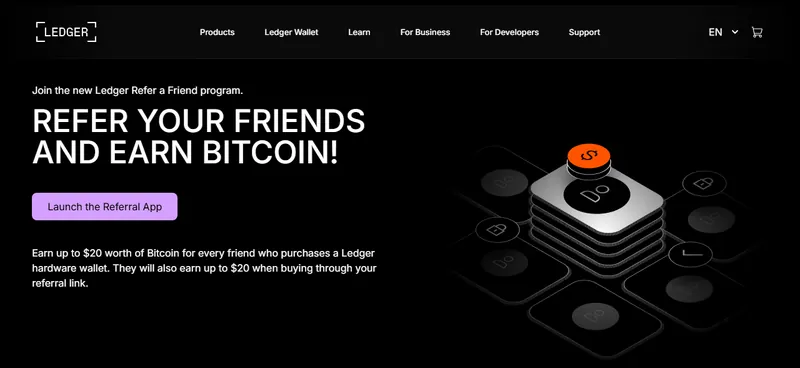
1. The Bitcoin referral program, the one permanent benefit. Referrer and referee each receive up to $20 in BTC depending on the device: $5 for a Nano S Plus (€79) or a Nano X (€149), $10 for a Nano Gen5 (€179), $20 for a Flex (€249) or a Stax (€399). Our code: 2QH17AVC4QQSQ. The reward is claimable after 30 days in the Ledger Wallet app, under Discover > Refer a Friend.
2. The upgrade program (20% off), reserved for owners of an older Nano — detailed just below.
3. One-off partner codes, negotiated with a media outlet or an app for a few weeks: FINIMIZE20L (20% off), Color20 and Color30 on the Nano Color, NYKNYC and MOVESOL2LEDGER (10% off). None is valid today.
4. Seasonal campaigns, Black Friday above all, where Ledger has already pushed the referral bonus up to $30 in bitcoin.
The logic is the same as at Zengo: at Ledger the discount is not typed into a "promo code" field, it is triggered by a link.
The Ledger upgrade program: 20% off a Gen5, Flex or Stax
This is the only percentage discount genuinely active at Ledger, and almost no coupon site mentions it. The Ledger Nano Upgrade Program grants 20% off to owners of a Nano S (2016), a Nano S Plus or a Nano X who move up to a touchscreen model: Nano Gen5, Flex or Stax. Applied to the public prices checked in July 2026, that works out at roughly €143 instead of €179 for the Gen5, €199 instead of €249 for the Flex and €319 instead of €399 for the Stax.
Eligibility is checked from a desktop computer on the official program page (shop.ledger.com/pages/ledger-nano-upgrade-program): the offer is not open to a first purchase.
Upgrade or referral? The two do not stack, since the referral requires a full-price purchase. The maths is quick: on a Nano Gen5 the upgrade saves €35.80 straight away, against $10 in bitcoin paid out after 30 days through the referral. If you already own a Nano, the upgrade wins. If this is your first Ledger, the referral is the only benefit you qualify for.
About Ledger
Ledger is a French company founded in 2014 in Paris, which in under ten years became the world leader in hardware wallets (physical cryptocurrency wallets). With several million devices sold in more than 200 countries, Ledger today protects a significant share of crypto-assets held in self-custody worldwide. The company is a French unicorn (over a billion dollars in valuation). The range now spans five devices: the Nano S Plus (€79) as the entry model, the Nano X (€149) with Bluetooth, the Nano Gen5 (€179, launched 23 October 2025) with a curved E Ink touchscreen and NFC, the Flex (€249) and the premium Stax (€399). All are managed via the Ledger Wallet app (the new name of Ledger Live since October 2025). For a mobile self-custody wallet with no physical device, also see Zengo.
How does a Ledger hardware wallet work?
A Ledger hardware wallet is a physical device designed to store cryptocurrency private keys completely offline (cold storage). The private key is generated and stored exclusively in the device's secure chip and never leaves it. To sign a transaction (send crypto), you must physically press the device's buttons: someone with access to your computer or phone can't transact without the device in hand. The 24-word recovery phrase (seed phrase) is the backup of your private keys. If the device is lost or stolen, it lets you restore the entire wallet on a new Ledger. It's imperative to write this phrase on paper and keep it safe, never entering it on a computer or photographing it.
The Ledger product range
The Ledger range has five models (official prices checked in July 2026). The Nano S Plus (€79) is the entry model: OLED screen, 2 physical buttons, USB-C, ideal for beginners. The Nano X (€149) adds Bluetooth (iOS and Android) and a rechargeable battery. The Nano Gen5 (€179), launched on 23 October 2025, modernises the Nano family: 2.8-inch curved E Ink touchscreen, USB-C + Bluetooth 5.2 + NFC, Recovery Key included, four colours. The Ledger Flex (€249) has a 2.84-inch colour E Ink touchscreen. The Ledger Stax (€399) is the premium model with a 3.7-inch curved E Ink screen and Qi wireless charging — Flex and Stax were designed with iconic designer Tony Fadell (creator of the iPod). Note: the original Nano S (2016) was discontinued in 2022 and stopped receiving security updates in late 2025 — don't confuse it with the S Plus.
The security of Ledger hardware wallets
Security is Ledger's core business. Ledger devices integrate a Secure Element chip certified EAL5+ to EAL6+ depending on the model. This chip is identical to those used in biometric passports and bank cards, designed to resist physical attacks (probe, cold, heat, laser). The BOLOS architecture (Blockchain Open Ledger Operating System) is Ledger's proprietary operating system, isolating each blockchain app in a separate secure environment. Ledger has a Donjon team (security research) tasked with testing its own devices and finding vulnerabilities before malicious actors. Firmwares are regularly updated via Ledger Live to fix any vulnerabilities and add features. No Ledger device has ever been hacked remotely since the company's creation.
The Ledger Wallet app (formerly Ledger Live)
In October 2025, alongside the Nano Gen5 launch, Ledger Live was renamed Ledger Wallet. It is the software interface to manage all your crypto-assets from one place. Available on Windows, macOS, Linux, iOS and Android, it lets you view balances in real time, send and receive crypto, and buy, sell and swap via integrated partners (MoonPay, Coinify, Changelly, 1inch). The app includes staking and earn features, natively manages 500+ coins — and thousands of tokens across the major blockchains (Bitcoin, Ethereum, Solana, XRP, stablecoins…). Ledger Wallet is also where referral rewards and BTC vouchers are claimed (Discover > Refer a Friend). Device firmware updates are done directly in the app.
Which cryptocurrencies are compatible with Ledger?
Ledger no longer advertises the old "5,500 coins" figure: the official supported-assets page now says the app supports thousands of cryptocurrencies, with 500+ managed natively in the Ledger Wallet app. The main natively supported blockchains are Bitcoin (BTC), Ethereum (ETH) and all ERC-20 tokens, Solana (SOL), XRP, Cardano (ADA), Polkadot (DOT), Avalanche (AVAX), BNB Chain (BNB), Polygon, Cosmos (ATOM), Litecoin (LTC), Bitcoin Cash (BCH), Dogecoin (DOGE) and hundreds of others. For ERC-20 tokens (over 10,000 on Ethereum), Ledger Wallet automatically manages compatibility via the Ethereum app. Third-party apps (MetaMask, MyEtherWallet) can be connected to a Ledger to access DeFi and NFT protocols not natively managed.
How to buy a Ledger and avoid counterfeits
It's imperative to buy a Ledger only from the official Ledger.com site or officially listed authorised resellers. Devices bought second-hand or on unofficial platforms (third-party marketplace sellers, eBay, Telegram groups) present a major risk: a device pre-configured with a seed phrase known to the sender would let them steal all your crypto as soon as you transfer it. Fundamental reminder: a new Ledger ALWAYS generates its own seed phrase on first setup. If a device asks you to enter a seed phrase provided by the seller or arrives already configured, never use it. Also worth knowing: BTC vouchers are occasionally included in the box and redeemable in the Ledger Wallet app. Beyond that, no permanent public discount code exists at Ledger — the three official levers (Bitcoin referral, the 20% upgrade program, seasonal campaigns) are detailed at the top of this page.
Ledger vs Trezor: comparing the two leaders
Ledger and Trezor (a Czech brand, founded in 2013) are the two world references in hardware wallets. The main differences: Ledger uses a certified Secure Element chip (like bank cards), Trezor uses a standard microcontroller that is open-source but considered less resistant to physical attacks by some security experts. Trezor publishes all its code as open-source; Ledger publishes the apps' code but not the secure chip's firmware. Ledger offers Bluetooth on the Nano X (absent on Trezor Model T and Safe 5). Both brands have had incidents: Ledger suffered a customer-data leak in 2020 (emails and addresses) and the Ledger Recover controversy in 2023; Trezor had pin vulnerabilities in 2023. For the vast majority of users, both brands offer largely sufficient security.
Ledger Recover: the 2023 controversy
In May 2023, Ledger launched Ledger Recover, an optional service ($3.99/month) to back up your seed phrase in encrypted, fragmented form with three custodians. This announcement caused major controversy in the crypto community, as it implied Ledger firmware could theoretically extract the seed phrase from the secure chip — something Ledger had always presented as impossible. The controversy highlighted that the separation between chip and firmware isn't inherently hermetic at the hardware level, but rests on trust in Ledger's firmware. Ledger clarified that the service is strictly optional and that Recover features require identity verification (KYC). Trust in Ledger remains very high in the community despite this episode, but it's important to be aware of it before buying.
Ledger for businesses and institutions
Beyond the general public, Ledger offers professional solutions via Ledger Enterprise. This solution lets companies, investment funds, exchanges and financial institutions manage their crypto-assets with advanced governance: multi-signature (multisig), approval workflows, audit logs, HSM integration. Ledger Vault (now Ledger Enterprise) has been used by banks, funds and exchanges to secure billions of dollars of crypto-assets. MPC (Multi-Party Computation) technology is integrated for distributed signature schemes with no single point of failure. These institutional solutions helped anchor Ledger's reputation as a security reference beyond the consumer market.
Ledger customer reviews and reputation
Ledger has a solid reputation in the global crypto community despite some controversies. The unanimously recognised positives: the hardware and software robustness of the devices, very broad coin compatibility, the mature Ledger Wallet interface, quality technical support and long-term reliability (original Nano S devices from 2016 still work). The watch-outs: the 2020 customer-data leak (emails and addresses exposed, phishing waves followed) and the 2023 Ledger Recover controversy. On a purely hardware and cryptographic level, no asset has ever been compromised via a flaw in the Ledger device itself. The Ledger referral program (our link with code 2QH17AVC4QQSQ) pays up to $20 in Bitcoin to each side: $5 for a Nano S Plus or Nano X, $10 for a Nano Gen5, $20 for a Flex or Stax — full-price purchases on the official site only, reward claimable after 30 days. For a mobile-first self-custody wallet, also compare Zengo.
Frequently asked questions
How do I use a Ledger referral code?
Buy a Ledger device at full price via a referral link on the official Ledger.com: referrer and referee each receive Bitcoin depending on the model — $5 for a Nano S Plus or Nano X, $10 for a Nano Gen5, $20 for a Flex or Stax. The reward is claimable after 30 days in the Ledger Wallet app; it cannot be combined with promotions. Always buy from the official site to avoid pre-configured fakes.
How much does a Ledger cost?
The Nano S Plus is €79 (entry), the Nano X €149 (Bluetooth and battery), the Nano Gen5 €179 (curved E Ink touchscreen, NFC, launched October 2025), the Flex €249 and the Stax €399 (premium curved E Ink, wireless charging). All are managed via the Ledger Wallet app.
How does a Ledger keep crypto safe?
Your private keys are generated and stored offline in a certified Secure Element chip (EAL5+/EAL6+, as in bank cards) and never leave the device; transactions require a physical button press. The 24-word seed phrase is your backup — keep it on paper, never digital.
Where should I buy a Ledger?
Only from the official Ledger.com or officially listed authorised resellers. Never buy second-hand or from unofficial sellers — a device pre-loaded with someone else's seed phrase would let them steal your funds. A new Ledger always generates its own seed phrase on first setup.
Ledger or Trezor?
Ledger uses a certified Secure Element chip and offers Bluetooth (Nano X) and the widest coin support; Trezor is fully open-source but uses a standard microcontroller. Both are highly secure for most users; both have had past incidents. Choose Ledger for Secure Element and app range.
What was the Ledger Recover controversy?
In 2023 Ledger launched an optional ($3.99/month) encrypted seed-phrase backup service, sparking debate because it implied the firmware could extract the seed from the secure chip. It's strictly optional with KYC; trust in Ledger remains high, but it's worth knowing before buying.
Is there a free-shipping Ledger promo code?
No. Ledger does not issue any public free-shipping code: coupon sites advertising one are recycling expired partner codes. Shipping is calculated at checkout on shop.ledger.com based on your delivery country and the shipping method chosen, and no third-party code cancels it. The only benefit genuinely available on your order is the Bitcoin referral, up to $20 depending on the device.
Does the FINIMIZE20L promo code still work?
This 20%-off code is still displayed on an official Ledger page (ledger.com/fr/finimize), a leftover from a partnership with the Finimize app — which is why that page still surfaces in Google results for Ledger promo codes. But the page ties it to the Ledger Nano S, a device discontinued in 2022 and without security updates since late 2025: the code therefore applies to no currently sold model. That is the fate of almost every Ledger partner code found online.