BUX Referral Code 2026: Free Share up to €200
Your opinion matters: rate this offer
Promo offer

BUX
Up to €200Valid on BUX • Click to claim the offer
About this offer
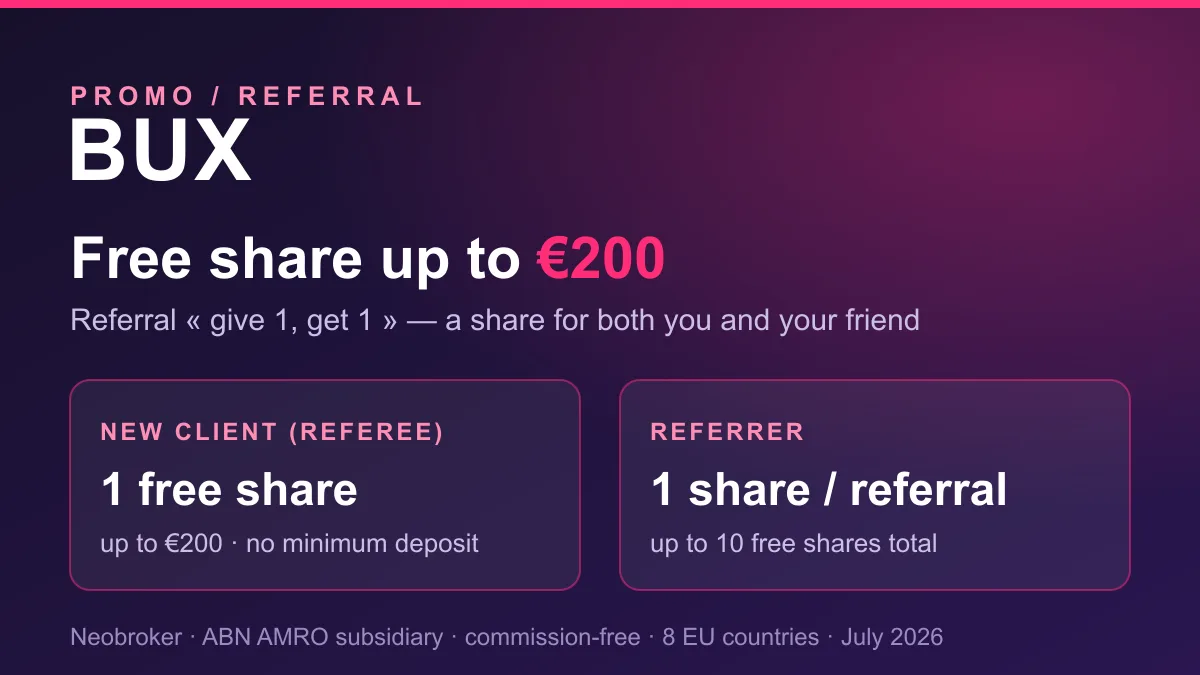
Open a BUX account through a referral link and you receive a free share worth up to €200, with no minimum deposit — and the referrer gets a free share too (a "give 1, get 1" model, capped at 10 shares). BUX is a European neobroker founded in 2013 in the Netherlands, an ABN AMRO subsidiary since July 2024, letting you invest commission-free in stocks and ETFs. Available across 8 European countries (Netherlands, Belgium, France, Germany, Austria, Spain, Ireland, Italy), BUX has more than a million customers.
Click the promo link to access the Up to €200 on BUX. This offer is verified and regularly updated.
What is BUX?
BUX is a European neobroker founded in 2013 in Amsterdam (Netherlands), which began as a gamified trading app before pivoting to serious investing. In 2024, ABN AMRO, one of the largest banks in the Netherlands, completed its full acquisition of BUX. In February 2026, Marlou Jenniskens became CEO, succeeding co-founder Yorick Naeff. In 2026, BUX has more than a million customers across 8 European countries: France, the Netherlands, Belgium, Germany, Austria, Spain, Ireland and Italy. It positions itself as the broker for young European investors, with a mobile-first experience and commission-free savings plans on stocks and ETFs. To compare alternatives, see Trade Republic or Scalable Capital.
BUX referral code: the free share up to €200
BUX doesn't hand out a classic promo code to type in — the perk comes through a referral link. Open your account via that link and you get a free share worth up to €200 (Apple, Coca-Cola, GoPro… drawn at random), with no minimum deposit. The referrer also gets a free share once the new client funds their account: this is the "give 1, get 1" model, capped at 10 free shares per referrer.
| Who | Reward | Condition |
|---|---|---|
| New client (referee) | 1 free share (up to €200) | Sign up via a referral link + first top-up |
| Referrer | 1 free share per referee | The referee opens and funds their account (max 10) |
How to claim: 1) open the BUX app via a referral link; 2) verify your identity (securities account, 18+); 3) fund it by SEPA transfer or card; 4) receive your free share. Note: a lock-up period may apply before you can sell the free share, and BUX can change or end the offer at any time. Unlike a cash bonus such as Trade Republic, the BUX reward is a share you keep in your portfolio. Terms checked July 2026.
Commission-free investing on BUX
BUX's main draw is its commission-free order model. You can buy and sell European and US stocks and ETFs with no per-order brokerage fee. The model is similar to Trade Republic or Degiro. BUX earns revenue from the spread (the gap between buy and sell prices) and from interest on cash. Automatic savings plans let you schedule regular investments (DCA) from a few euros, with no fees. This is ideal for investing regularly in ETFs like the MSCI World or S&P 500 over the long term, without worrying about market timing.
BUX and the ABN AMRO acquisition
The acquisition of BUX by ABN AMRO in 2024 is a major turning point. ABN AMRO is one of the three largest banks in the Netherlands, with a balance sheet in the hundreds of billions of euros. This integration gives BUX financial strength and institutional credibility few independent neobrokers can claim. For users, it means better asset protection (Dutch guarantee scheme), potentially new features from the ABN AMRO ecosystem, and assured long-term continuity. Unlike more fragile independent fintechs, BUX now has the backing of a major banking group — a strong argument against Trade Republic (VC-backed).
The assets available on BUX
BUX offers a catalogue focused on long-term investing: stocks from the main European exchanges (Euronext Paris, Xetra, AEX, etc.) and US markets (NYSE, NASDAQ), plus a broad range of ETFs covering major global indices (MSCI World, S&P 500, FTSE All-World, CAC 40, etc.). Thematic ETFs (tech, clean energy, emerging markets) are also available. BUX discontinued direct crypto trading in March 2024, but now lets you invest in Bitcoin and Ethereum via crypto ETPs (exchange-traded products bought like an ETF). It does not offer leveraged CFDs or complex derivatives — a deliberate stance to protect beginners. To buy crypto directly, turn to Bitvavo or Bybit. For ultra-low-fee stock trading, Bourse Direct remains very competitive.
BUX automatic savings plans
The savings plans feature is one of BUX's most popular. You set a fixed amount (e.g. €50/month) on an ETF or stock, and BUX makes the purchase automatically at your chosen frequency — commission-free. This DCA (Dollar Cost Averaging) approach is ideal for long-term investors: by investing regularly regardless of price, you smooth your entry price over years. With an MSCI World ETF, for example, €100/month for 10 years on BUX costs zero in brokerage fees, unlike Bourse Direct (per-order fees) or Fortuneo. The model is directly inspired by Trade Republic's success in Germany.
Security and regulation of BUX
BUX is regulated by the AFM (Dutch Authority for the Financial Markets) and the DNB (Dutch Central Bank). Securities held on BUX are segregated from the platform's own assets in a separate legal entity — protecting your investments if BUX runs into trouble. Cash is covered by the Dutch deposit-guarantee scheme up to €100,000. Since the ABN AMRO acquisition, BUX also benefits from the strength of a major banking group. For users across Europe, BUX operates under the EU passport, allowing it to offer services throughout the EU under MiFID II. This is comparable to the regulatory protection of Bitvavo (DNB).
BUX app and user experience
The BUX app (iOS and Android) is built to be intuitive and beginner-friendly. The interface clearly shows your portfolio, per-asset performance, and makes buying a few taps away. Educational cards on each stock or ETF help beginners understand what they are investing in. BUX also includes price alerts and performance history. On the App Store, the app scores 4.5/5. Compared with Bourse Direct (more technical) or Trade Republic (a direct competitor), BUX positions itself as the most educational option for first-time European investors.
BUX vs Trade Republic vs Degiro, and our verdict
The commission-free European neobroker market is crowded. BUX: commission-free, automatic savings plans, an ABN AMRO subsidiary, 8 countries, long-term focus. Trade Republic: per-order fee (free on savings plans), a European banking licence, 1% cashback. Degiro: very low fees, a broad catalogue. Bourse Direct: a long-standing French broker with tax-advantaged accounts.
Our verdict: BUX is a solid neobroker for European investors wanting to invest simply and fee-free in stocks and ETFs. The 2024 ABN AMRO acquisition strengthens its credibility and longevity. Strengths: zero commission, automatic savings plans, ABN AMRO backing, rigorous Dutch regulation, an educational interface. Weaknesses: no tax-advantaged local accounts in some markets, no crypto, a narrower catalogue than Degiro, spreads on one-off orders. Ideal for beginners investing regularly in ETFs without fees.
Frequently asked questions
Is there a BUX promo code?
BUX has no classic promo code to type in. The perk comes through a referral link: open your account via the link and fund it, and you receive a free share worth up to €200, with no minimum deposit. There's no code to copy and paste.
Is BUX available across Europe?
Yes, BUX is available in 8 European markets including France, the Netherlands, Belgium and Germany. It is regulated by the Dutch AFM and operates under the EU MiFID II passport. Residents can open an account and invest in minutes.
Is BUX really commission-free?
Yes, BUX charges no per-order commission on stocks and ETFs. Revenue comes from the spread (buy/sell gap) and interest on cash. Automatic savings plans are also free.
Who owns BUX in 2026?
BUX has been a subsidiary of ABN AMRO since the acquisition was completed in 2024. ABN AMRO is one of the three largest banks in the Netherlands. Marlou Jenniskens has been CEO since February 2026, succeeding co-founder Yorick Naeff.
Does BUX offer tax-advantaged accounts?
BUX invests through a standard securities account, subject to your local capital-gains tax rules. For tax-advantaged wrappers (such as a French PEA), you would need a local broker like Bourse Direct or Fortuneo.
Can I buy ETFs on BUX?
Yes, BUX offers a broad ETF catalogue covering the main global indices: MSCI World, S&P 500, FTSE All-World, CAC 40 and many thematic ETFs. ETFs can be bought one-off or via automatic savings plans, commission-free.
Is BUX secure?
Yes, BUX is regulated by the AFM and DNB (Netherlands). Securities are segregated in a separate entity. Since the ABN AMRO acquisition, BUX benefits from a major bank's strength. Cash is covered by the Dutch guarantee scheme up to €100,000.
How do savings plans work on BUX?
BUX savings plans let you schedule automatic purchases of stocks or ETFs at regular intervals (weekly, monthly). You set the amount (e.g. €50/month) and BUX buys automatically. These plans are commission-free and ideal for a long-term DCA strategy.
How do I deposit funds on BUX?
Deposits are by SEPA transfer from your bank (free, 1-2 business days) or by Visa/Mastercard for instant credit. Withdrawals to your bank account are also free. Most European banks with a SEPA IBAN are accepted.
How do I get the BUX free share up to €200?
Open the BUX app via a referral link, verify your identity (18+, securities account), then fund your account by SEPA transfer or card. The free share (random value, up to €200) is credited after your first top-up. A lock-up period may apply before you can sell it.
Does the BUX referral also reward the referrer?
Yes. BUX uses a "give 1, get 1" model: each referee who opens and funds an account earns the referrer a free share, on top of the share the referee receives. A referrer can collect up to 10 free shares. BUX may change or end the programme at any time.