RealT Promo Code 2026: The Platform Is in Liquidation
Be the first to rate this offer
Promo offer

RealT
In liquidation (2026)Offer temporarily unavailable
Valid on RealT • Click to claim the offer
About this offer
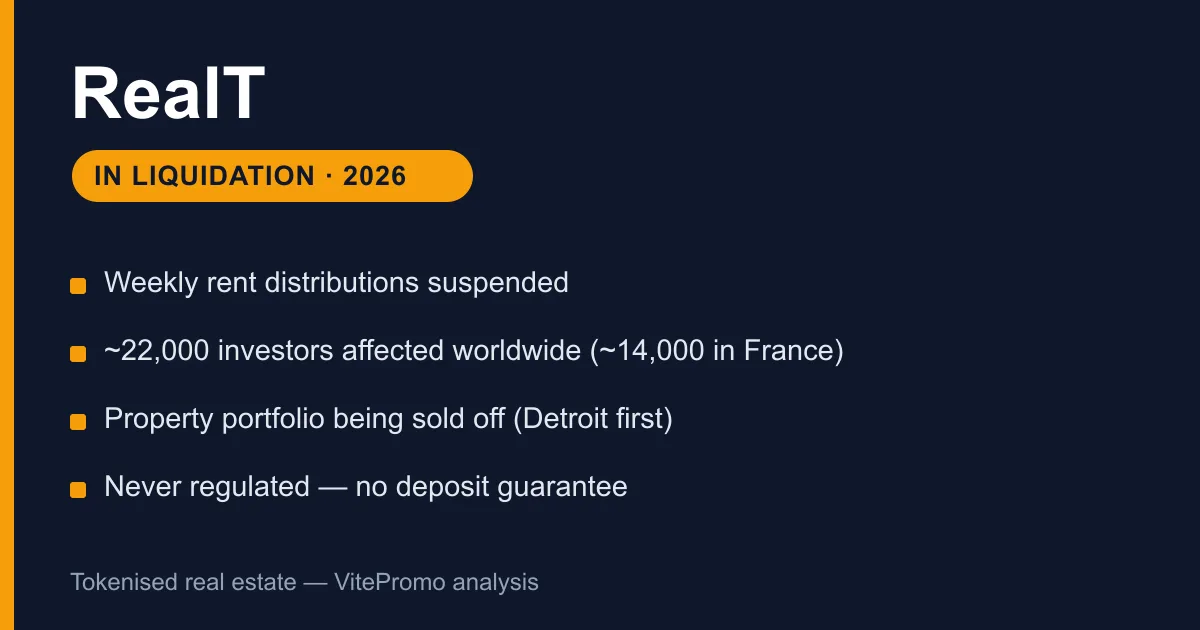
- RealT has been in judicial liquidation since July 2026: the founders announced the gradual sell-off of the entire property portfolio
- Weekly rent distributions are suspended; around 22,000 investors worldwide (~14,000 in France) are affected
- The RealT "promo code" / referral (approx. 2% cashback for the referrer) is now pointless — do not commit any new funds
- Never regulated by the AMF or any local authority: no deposit guarantee, no ombudsman, risk of total capital loss
- Legal recourse under way: a class action (Delomel law firm) and a criminal complaint filed with the Paris prosecutor
Enjoy the In liquidation (2026) on RealT. This offer is verified and regularly updated.
RealT enters liquidation in 2026: what is happening
In July 2026, RealT co-founders Rémy and Jean-Marc Jacobson announced during a community call that the platform had begun a judicial liquidation procedure. "We have initiated a liquidation procedure. We will sell each asset," said Jean-Marc Jacobson.
In practice, RealT is gradually selling off its entire property portfolio — prioritising Detroit assets, which make up roughly 83 % of holdings — and weekly rent distributions are suspended. The escrow account mentioned held only about $640,000, a fraction of the sums invested.
In total, around 22,000 investors worldwide — including some 14,000 in France — are affected. If you were looking for a "RealT promo code" to invest today, the honest answer is blunt: do not commit any new funds to the platform.
The Detroit litigation behind the collapse
The liquidation did not come out of nowhere. Since July 2025, the city of Detroit has been pursuing RealT over housing-code violations and unpaid property taxes on roughly 408 properties.
In April 2026, a court settlement led to the appointment of an independent trustee, Charles Bullock, with broad powers over about 700 properties: funding renovations, selling assets, or demolishing buildings deemed unsafe.
The trustee's work above all exposed the gap between the advertised yields — often shown at 9–11 % — and the actual condition of the underlying real estate, something a token holder had no way to verify.
The RealT promo code and referral: how it worked
There was never a genuine "RealT promo code" in the e-commerce discount sense. What referral sites called a "RealT promo code" or "referral code" actually pointed to the platform's referral programme.
How it really worked: the referrer earned about 2 % cashback in RealTokens on the purchases made by the person they referred. The referred user got nothing by default — some referrers passed on part or all of their commission to attract sign-ups, which is where the "2 % cashback" promises came from. It was a referrer-side benefit, never a guaranteed welcome discount.
Since the liquidation and the suspension of rent payments, this mechanism is pointless: cashback paid in the tokens of a platform being wound down carries no reliable value. That is why this page no longer relays any RealT code or referral link.
Tokenised real estate: what you actually owned
At its peak, RealT had tokenised more than 650 US properties for a total exceeding $138 million. Each property was held by a US LLC, and the tokens you bought represented shares in that LLC — not a real estate title in the usual legal sense.
In practice you owned a fraction of a building through digital tokens, issued first on Ethereum and later migrated to the Gnosis Chain (xDai) to cut gas fees. Rents were paid weekly in stablecoins (xDAI or USDC) to your crypto wallet.
This structure partly explains today's situation: in a default, token holders become creditors of a tangle of US LLCs, without the protective framework that regulated fractional real estate enjoys elsewhere.
RealT fees that ate into real returns
RealT's fee structure was less visible than it looked. At purchase, roughly 10 % in fees was built into the token price rather than shown separately. On rents, two layers stacked up: 6–8 % to the property manager plus 2 % taken by RealT. Reselling on the internal marketplace cost 3 %, with highly variable liquidity.
The result: the net yield actually received was well below the advertised gross figure — and the gap widened as the condition of the Detroit portfolio deteriorated. Fees alone were never the main risk; the lack of regulation and the state of the underlying assets were.
RealT key facts at a glance
The essentials on the RealT platform:
| Feature | Detail |
|---|---|
| Status (2026) | In judicial liquidation |
| Rents | Weekly distributions suspended |
| Entry ticket (historical) | From ~$50 per token |
| Purchase fees | ~10 % of the property price |
| Management fees | 6–8 % of rents + 2 % RealT |
| Resale fees | 3 % on the marketplace |
| Regulation | Not locally regulated |
| Currency | Crypto only (USDC, xDAI) |
| Investors affected | ~14,000 in France (~22,000 worldwide) |
Capital-loss risk: maximal. In liquidation, the recovery value of tokens is uncertain and depends on the proceeds of the property sales.
What affected investors can do
If you hold RealTokens, several actions are under way that you can join.
A class action is being coordinated in France by the Delomel law firm, with a registration fee of around €360 per participant. In parallel, a criminal complaint has been filed with the Paris prosecutor (financial division), and about 400 French nationals had already taken action by the time of the announcement.
Crucially, RealT was never approved by the AMF or any local regulator. There is therefore no deposit guarantee, no ombudsman and no compensation fund. Recovery will run through the sale of the US properties — a process described as lengthy and eroded by legal fees. Before acting, get support from a lawyer and a tax adviser.
RealT review 2026: our verdict
Our verdict is unambiguous in 2026. RealT will be remembered as a pioneer of tokenised real estate, but its entry into judicial liquidation, the suspension of rents and the Detroit lawsuits make it a platform on which no new capital should be committed.
If you have never invested: stay away. No "promo code" or referral bonus offsets the risk of a platform in liquidation.
If you hold tokens: join the class action (Delomel law firm), watch official communications about the asset sell-off, and consult a lawyer and a tax adviser — rents already received in stablecoins and any token disposals still need to be declared.
For real estate investing with a regulatory safety net, compare regulated fractional-investment platforms instead of unregulated tokenisation.
Frequently asked questions
Is RealT bankrupt or in liquidation?
RealT entered judicial liquidation in July 2026. The co-founders announced the gradual sell-off of the entire property portfolio, and weekly rent distributions are suspended. The platform is no longer a viable investment: do not commit any new funds.
Is the RealT promo or referral code still valid?
It is pointless now. The "RealT promo code" actually referred to the referral programme: about 2 % cashback in tokens for the referrer, and nothing for the referred user by default. Since the liquidation and the suspension of rents, cashback paid in RealTokens has no reliable value. This page no longer relays any code.
Will I get my money back from RealT?
It is uncertain. Recovery will depend on the proceeds from selling the US properties — a process described as lengthy and reduced by legal fees. The escrow account held only about $640,000. There is no deposit guarantee, as RealT was never regulated.
Are RealT rents still being paid?
No. Weekly rent distributions in stablecoins (xDAI/USDC) have been suspended since the platform entered liquidation. Yet weekly rental income credited to the wallet was the platform's central selling point.
Was RealT regulated?
No. RealT operated from the US and was never approved by the AMF or any local regulator. Investors sat outside any protective framework: no deposit guarantee, no ombudsman and no regulated information documents.
What caused RealT's collapse?
A dispute with the city of Detroit since July 2025 (housing-code violations and unpaid property taxes on ~408 properties), the appointment of an independent trustee in April 2026, and the exposed gap between promised yields and the real condition of the portfolio — all heavily concentrated (~83 %) in Detroit.
What are safer alternatives to RealT?
For real estate, regulated fractional-investment platforms invest in euros on European assets under a supervisory framework. They do not remove the risk of capital loss, but they provide the regulatory oversight that RealT never had.